Monday, June 20, 2016

New GRADE working group guidance on assessing risk of bias associated with missing participant outcome data


The GRADE working group has recently adopted guidance for assessing the risk of bias associated with missing participant outcome data across an entire body of evidence. This post summarizes the guidance, provides a background, relevant references, and links to excel documents with calculators to facilitate the use of the guidance.


The Guidance
·      Start with a primary meta-analysis using a complete case analysis (i.e., excluding those with missing data)
·      Then conduct sensitivity meta-analyses imputing, in each study, data for those with missing data, and then pooling across studies. 
o   For binary outcomes: we suggest use of “plausible worst case” in which review authors assume that those with missing data in treatment arms have proportionally higher event rates than those followed successfully. 
o   For continuous outcomes: use imputed mean values from other studies within the systematic review, and the standard deviation from the median standard deviations of the control arms of all studies.  For meta-analyses in which investigators have used different instruments to address the same construct, convert all scores to standardized mean difference (SMD) or to the units of a selected reference instrument. 
·      If the results of the primary meta-analysis are robust to the most extreme plausible assumptions, do not rate down quality of evidence for risk of bias due to missing participant outcome data. 
·      If the results of the primary meta-analysis are not robust to the most extreme plausible assumptions, consider rating down quality for risk of bias.  


References


Links to MPD assumptions calculators

Binary variables: A freely downloadable Excel document to determine the numerators and denominators to be used for each trial included in the metaanalysis according to the selected assumption: https://www.dropbox.com/s/opstwgm45qiq57k/Assumptions%20about%20MPD%20v5.xls?dl=0

Continuous variables: A freely downloadable Excel document to determine the means and SDs to be used for each trial included in the meta-analysis according to the selected assumption per strategy:


Wednesday, April 13, 2016

List of Ongoing International Guideline Development Projects

The ongoing international guideline development efforts in which members of the AUB GRADE Center are currently involved in:

  • Guidelines on Health-related Rehabilitation being developed by the WHO;
  • Guidelines on Potassium Iodide Thyroid Blocking in Radiological and Nuclear Emergencies being developed by the WHO;
  • Guidelines on Community based practitioners' integration being developed by the WHO;
  • Guidelines on Enhancing Preparedness for Crimean-Congo Hemorrhagic Fever being developed by the WHO;
  • Clinical Practice Guidelines on Venous Thromboembolism being developed by the American Society of Haematology (ASH);
  • Adaptation of Rheumatoid Arthritis Guidelines for the Eastern Mediterranean Region being developed by Weill Cornell Medical College- Qatar and the Middle East Rheumatoid Arthritis Consortium (MERAC);
  • Pilot Guideline on Sickle Cell Disease being developed by RARE Best Practices;
  • Evidence Based Infectious Diseases Guidance for newly arriving migrants to the European Union being developed by the European Centre for Disease Prevention and Control (ECDC). 

List of Completed International Guideline Development Projects

The international guideline development efforts in which members of the AUB GRADE Center have recently been involved in: 

  • Guidelines for the Treatment of Ankylosing Spondylitis and Non-radiographic Axial Spondyloarthritis, developed by the American College of Rheumatology, Link;
  • Guidelines for the Treatment of Rheumatoid Arthritis, developed by the American  College of RheumatologyLink;
  • Guidelines for the Treatment of Thromboembolic diseases, developed by the American College of Chest Physicians, Link;
  • World Health Organisation (WHO) guidelines for the Verification of Elimination of Human OnchocerciasisLink.

The World Health Organisation Guidelines on Health-related Rehabilitation

The Assistant Director of the AUB GRADE Center, Dr. Andrea Darzi, recently served as the methodologist for the development of the WHO Guidelines for Health-related Rehabilitation. The meeting took place at the WHO headquarters in Geneva, Switzerland on 16-17 March 2016.

Monday, March 14, 2016

Ministry of Health of the Kingdom of Saudi Arabia Guidelines Project

Elie Akl, Andrea Darzi and Reem Waziry contributed to the 2015 Ministry of Health of the Kingdom of Saudi Arabia Guidelines Project. They served as methodologists for the guidelines on (1) management of sickle cell disease and (2) prophylaxis of venous thromboembolism in medical patients and long distance travelers.

Evidence-based guidelines

Evidence-based_guideline_development
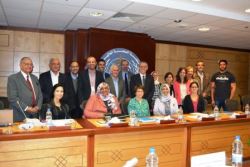
Elie Akl and Andrea Darzi participated in the EMRO Expert Consultation on Evidence-Based Guideline Development & Adaptation in the Eastern Mediterranean Region. An expert consultation on evidence-based guideline development and adaptation was organized at the Regional Office in Cairo, Egypt, from 18 to 19 November 2015. The consultation was in line with one of WHO’s core functions, which is the development of evidence-based guidelines which can guide health policy-makers, health care practitioners and users in making informed health decisions based on research findings and consensus among experts taking into account the local contexts and available resources.